Dunhuang: desert city on the ancient Silk Road
This northwestern Chinese city was once a flourishing trading hub. Today it draws visitors to extraordinary Buddhist cave temples and dramatic desert landscapes.
Worldway Travel · 8 November 2026
Where Dunhuang sits in history
Dunhuang lies in Gansu Province in northwest China, far from the country's major population centres. Two thousand years ago, it was anything but remote. The Han emperor established the city in 111 BC at a crossroads where two branches of the Silk Road met, making it a crucial stop for merchants moving goods between China and Central Asia. The name itself means "to flourish and prosper," reflecting its ancient importance. Though trade routes shifted over centuries and the city lost its commercial prominence, Dunhuang remains significant as a centre where Buddhism took root in China, travelling west along those same trade routes.
The Buddhist heritage here runs deep. For centuries, a kingdom called Western Xia ruled the region, and its rulers sponsored the construction of temples and cave shrines as an expression of faith. These caves and their contents—surviving from the 4th century onwards—make Dunhuang one of the most important Buddhist sites anywhere along the Silk Road.
Why travellers visit
Three main draw cards bring visitors to Dunhuang: ancient Buddhist art, desert landscapes and a sense of stepping back into a world-changing period of history. The Buddhist cave temples contain thousands of paintings, sculptures and manuscripts that illustrate the spread of a major religion across Asia. For many travellers, especially those with an interest in history or art, seeing these works in their original setting is far more moving than viewing artefacts in a museum thousands of kilometres away.
The desert setting itself has appeal. Dunhuang sits at the edge of one of China's great deserts, and the landscape around the city is strikingly different from the green, populated regions of eastern China. Golden sand dunes, stark rock formations and the contrast between arid wilderness and the oasis town create memorable scenery, particularly at sunrise or sunset.
Dunhuang also suits travellers who want to experience the Silk Road as a concept—a real historical trade network rather than just a name in textbooks. Walking through the city and visiting sites connected to that era helps place ancient trade, cultural exchange and the journey Buddhism took across Asia into tangible context.
The main sights
The Mogao Caves are the centrepiece. Located 25 kilometres from the town, these caves contain Buddhist artwork spanning more than a thousand years. Visitors typically see a selection of the caves, not all of them, as entry is managed to protect the artworks from damage. The frescoes, statues and carvings illustrate the evolution of Buddhist art as it encountered Chinese artistic traditions.
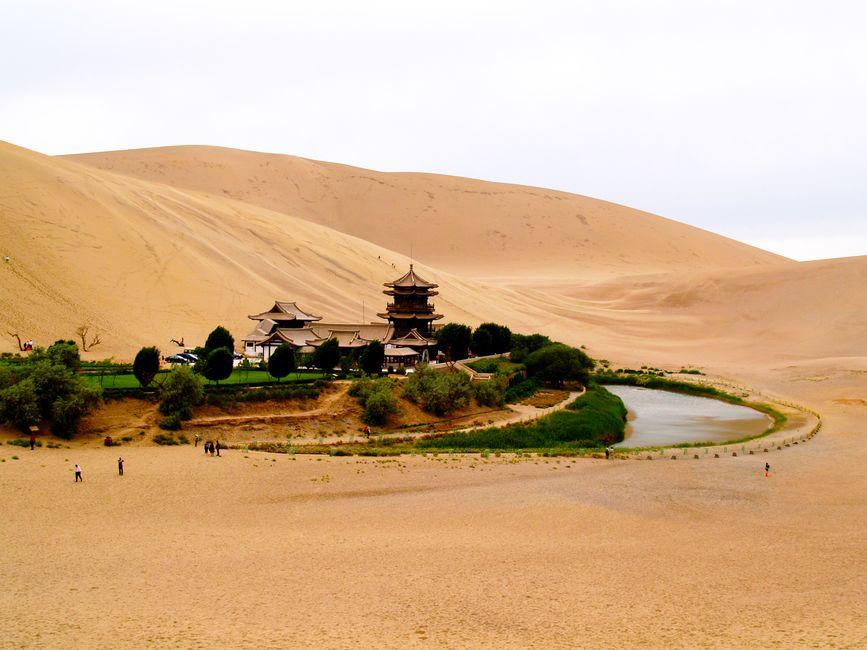
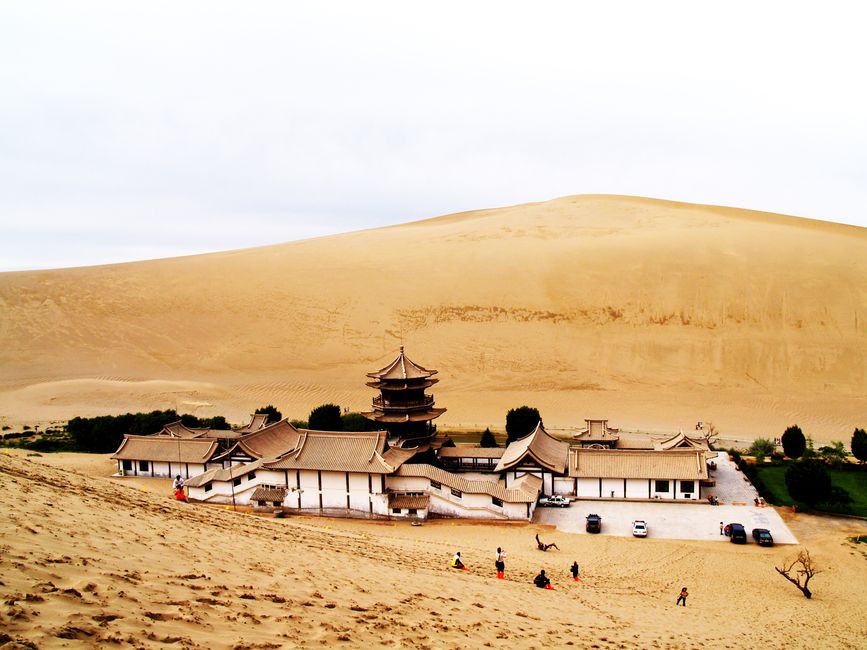
The Singing Sand Dunes and Crescent Lake provide the desert experience. The dunes really do produce a humming sound when sand shifts, a phenomenon that has intrigued visitors for centuries. A crescent-shaped lake sits at the base, fed by springs, creating an unexpected pocket of water surrounded by golden sand.
Beyond the main sights, several other locations tell stories of the Silk Road era. Ancient city ruins, mountain passes like Yang Pass and Yumen Pass, and film sets recreating historical Dunhuang offer quieter visits. Yardang rock formations create otherworldly landscapes where wind has carved the earth into strange shapes.
A museum in town displays artefacts and provides context for understanding the region's history, though the cave paintings themselves at Mogao remain the real attraction.
Getting there and moving around
Dunhuang Airport receives flights from Beijing, Lanzhou, Urumqi and Xi'an, though connections are less frequent than for major Chinese cities. The airport sits 13 kilometres from town; arrange airport pickup through accommodation rather than relying on taxis or shuttle buses.
Trains serve Dunhuang, though the station lies about 12 kilometres northeast of town. Many visitors find it easier to take a train to Liuyuan, a transport hub one to two hours away by bus, which offers more frequent connections to major cities including Xi'an, Lanzhou and Urumqi. Long-distance buses also connect Dunhuang to cities across northwest China, though journey times are substantial—Lanzhou takes 17 to 24 hours, for example.
Within Dunhuang itself, a regular city bus service runs to a limited number of sights. For the main attractions scattered across the desert, a special tourist shuttle bus operates two routes: an eastern route to Mogao Caves and the Singing Sand Dunes, and a western route to historical sites and dramatic landscape formations. Shuttle buses charge a flat fare and can collect passengers from hotels, making this the practical choice for most visitors.
Who finds Dunhuang rewarding
Dunhuang appeals strongly to travellers interested in Chinese history, Buddhism, or the Silk Road as a historical phenomenon. Art lovers and photographers find rich material in the cave paintings and desert light. Those seeking to see less-visited parts of China beyond the major tourist cities will find Dunhuang less crowded than Beijing or Shanghai, though still equipped with basic traveller services.
The combination of cultural significance and dramatic scenery makes it suitable for varied fitness levels and interests. The caves can be explored at a steady pace, while the sand dunes offer adventure for those who want it. Visiting Dunhuang typically requires several days to do it justice, and it works well as part of a longer journey through northwest China rather than as a day trip from elsewhere.