Leshan: a riverside Buddha and sacred mountain in Sichuan
Leshan centres on a colossal cliff-carved Buddha overlooking the meeting point of three rivers, plus Mount Emei nearby. Both are on the UNESCO World Heritage list.
Worldway Travel · 5 November 2026
What Leshan is
Leshan sits in central Sichuan Province where three rivers converge: the Dadu, Mín and Qingyi. For most visitors, the city itself is a stopover—what they come for is a single, extraordinary sight: the Leshan Giant Buddha, a 71-metre-high figure carved directly into the riverside cliff. That sculpture, together with the sacred Buddhist mountain of Mount Emei just beyond the city, forms a joint UNESCO World Heritage Site that draws visitors from across China and around the world.
The city has a long history—over 2,000 years—and was once an important hub for river transport in southern Sichuan. Today it remains a working city of ordinary size, not a theme park or heritage museum. It offers a straightforward way to see one of China's most famous artworks and access Mount Emei without the crowds and expense of staying in central tourist zones.
The Giant Buddha and why it was built
Construction of the Leshan Giant Buddha began in 713 AD during the Tang Dynasty and took 90 years to complete. The reason was practical: the junction where the three rivers meet had dangerous currents and whirlpools that regularly capsized boats and killed cargo animals. A Buddhist monk had the idea that a vast cliff carving would somehow protect travellers. Whether through spiritual power or because the carving work altered the riverbed and calmed the currents, the danger did eventually diminish.
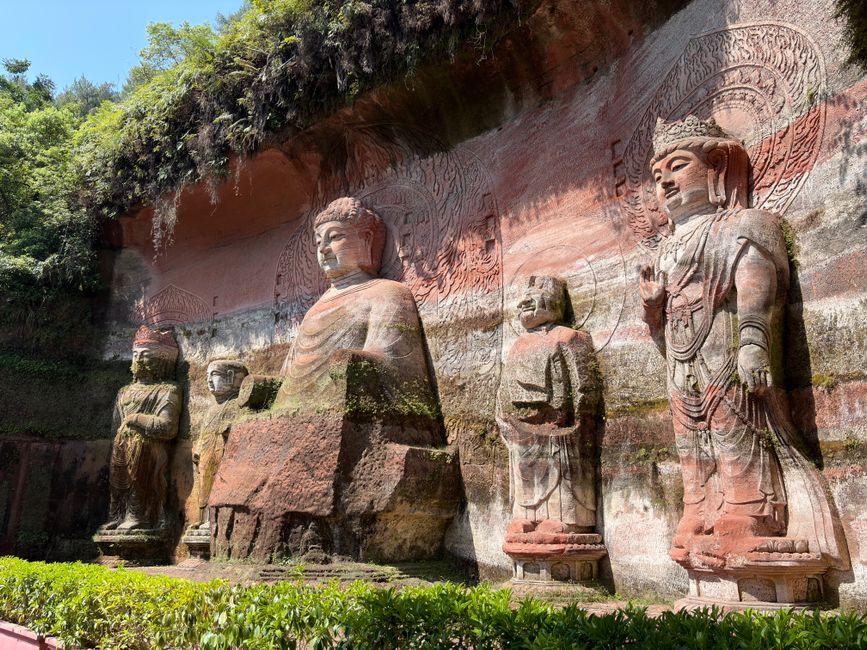
The finished Buddha sits 71 metres high, carved into the soft sandstone. Visitors can see it from the riverbank below, but the full experience involves walking down paths carved into the cliff face itself, passing dozens of smaller Buddha carvings along the way. The scale becomes apparent only when you stand at the Buddha's ear—it is large enough to fit dozens of people inside. The site also includes several temples, gardens and a beautiful stone bridge called Haoshang Bridge.
Getting there from Chengdu
Leshan is easily reached from Chengdu, the capital of Sichuan, about 150 kilometres away. The intercity high-speed train takes between 50 minutes and 1 hour 20 minutes; trains depart regularly from Chengdu East Station and Chengdu South Station. The journey is straightforward and comfortable—an option worth choosing if you prefer not to drive.
From Leshan Railway Station, bus K1 goes directly to the Giant Buddha area and runs through the city, taking about 30 minutes. The cost is minimal. Buses also arrive in Leshan from other parts of Sichuan and from neighbouring provinces; the Central Bus Station is a short walk from the railway station.
Mount Emei and combining sites
Mount Emei (Emeishan), one of Buddhism's four sacred mountains in China, lies just outside Leshan and is best visited as part of the same trip. The emeishan train station is at the end of the same high-speed line that comes from Chengdu through Leshan, so the two are natural companions. The mountain is famous for its walking trails, ancient temples and views across the valleys below. Many visitors do the Buddha on one day and Mount Emei on the next, or arrange it the other way round.
A one-day visit to the Giant Buddha is realistic; Mount Emei requires overnight stays if you want to experience it properly.
When to visit
Spring and autumn offer the best conditions—mild temperatures, comfortable humidity and moderate rainfall. Summer brings intense heat and very heavy rain, particularly from July to August; waterproof gear is essential if you travel then. Winters are cool and often overcast but rarely freezing.
Because Leshan and Mount Emei sit at the confluence of major rivers with complex weather patterns, conditions can change quickly. Bring layers and a rain jacket whatever time of year you visit.
Who Leshan suits
Leshan appeals most to travellers interested in Buddhist art and architecture, particularly those visiting China for the first time. The Giant Buddha is visually overwhelming and makes sense to almost anyone, whether or not they have studied Chinese history or Buddhism. The site feels authentic—it is a functioning religious place, not a reconstructed theme park.
The journey from Chengdu is short enough that Leshan works well in a one or two-week Sichuan itinerary. Combined with Mount Emei, the Chengdu region, or valleys further west such as Jiuzhai, it sits at a logical point on the map. The main drawback is that the city itself holds little for visitors beyond the Buddha and the nearby ebony museum; most travellers eat and sleep in Leshan but come for the sights beyond it.